
Table of Contents
ToggleHow to Choose the Perfect Wall Art for Your Living Room
Anyone who enjoys partaking in room decoration, they will have certain adversaries. For one thing, when at one point you just stare at a mellow and empty wall, you just have that lingering feeling as if you should put something aesthetic on it but can’t decide and are
conflicted. Often, any typical individual from the majority would just put anything random they have available but it gets too basic, even if it’s some generic frame. The room ends up looking fine. Fine is not the same as finished and that distinction lives almost entirely on the
walls.
Why Wall Art Is the Most Impactful Element in Living Room Decor
People look at the walls first. Not the furniture arrangement, not the rug, not the light fixture someone spent three weeks choosing. The walls, within the first second or two, before anything else gets a fair look.
That is not a small thing. It means the art on those walls is forming the room’s first impression before a guest has even sat down. Before they have touched the sofa or noticed the paint color. A strong piece on the right wall sets a tone that everything else in the room either supports or fights against.
And here is the part people tend to underestimate. Rooms with genuinely interesting art on the walls get remembered. Someone who visited six months ago will still bring up a specific piece in conversation.
How to Match Wall Art with Your Living Room Style and Color Palette

The problem almost always starts with shopping before reading the room.
Spend a few minutes looking at the space honestly before looking at any art. What is the furniture saying? Sharp edges, low profiles, clean upholstery suggest something more graphic or abstract will land well. Heavier wood, warmer tones, layered fabrics tend to welcome more traditional or heritage-influenced work. Neither direction is the right one in any absolute sense. They just call for different things on the walls.
Color gives you the most practical entry point. Find a tone that is already living somewhere in the room. A stripe in the rug, a thread in a cushion cover, the undertone in the curtain fabric. Then find art where that same tone turns up somewhere in the composition. It does not need to scream. A quiet visual link between the wall and the rest of the room is usually enough to make everything feel chosen rather than assembled.
Deliberate contrast is a legitimate strategy too. One bold piece against a quiet, neutral wall can define the whole room. That same piece hung with no thought given to its surroundings just looks like something that belongs somewhere else.
Wall art rarely works in isolation. Elements like curtains, cushions, and layered textures influence how the artwork feels within the room. These Best Living Room Curtain Ideas for Modern Homes offer inspiration for creating a modern and coordinated living space.
Choosing the Right Size and Scale of Wall Art for Your Space
Scale is the thing that catches people most off guard and the thing most difficult to visualize before a piece is actually on the wall. Something that felt substantial at the gallery looks almost apologetic on a wide living room wall. It happens constantly and it almost never occurs to anyone until they are standing there looking at it.
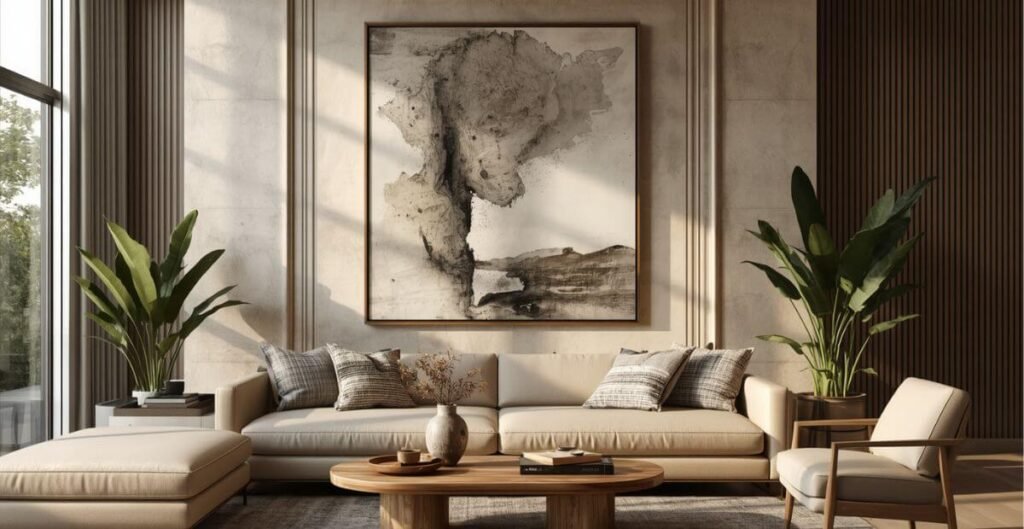
Behind a sofa, the working guideline most designers rely on is art that covers roughly two-thirds of the sofa’s width. For a wall with no furniture anchoring it below, somewhere in the 60 to 75 percent coverage range tends to read as intentional. Below that and the wall looks
unfinished. Above it and the room tips from cozy into overwhelming.
When you are thinking about the height, it is something that is often overlooked but that is a bad decision. In fact, the center of a piece should sit between 57 to 60 inches off the floor. That is standing at eye level for most people. Art hung above that range floats away from the room.
In fact, it leads to the loss of the alignment for the furniture around it.
How to Arrange Wall Art for Maximum Visual Impact

For gallery walls, the anchor piece goes up first. Start from the center, place the largest work and build outward from there. The arrangement grows around that anchor rather than being assembled from the edges inward.
Frame mixing can work without making a wall look chaotic, but the margin is narrower than most people assume going in. Two finishes that sit comfortably alongside each other, a warm wood and a soft black for example, tend to hold. Add a third competing finish and things start to pull apart. The line between layered and just busy is often that one decision.
Lighting is genuinely the most skipped step in this whole process, and it shows. A picture light mounted above a piece or a ceiling fixture angled at the wall brings out depth and warmth that flat ambient lighting never delivers. It makes the art look intentional. It also draws the eye toward the wall rather than letting attention wander. For any original works, sustained direct sun exposure is worth avoiding.
Where to Find the Perfect Wall Art for Your Living Room
When the living room gets to have an impact appeal even after you leave, as if it’s a vivid memory that rarely showcases from a few other sources, that is rare.
That observation is not really about money. It is about the fact that work designed to offend no one tends to move no one either. Safe, broadly appealing, widely distributed art fills walls without doing much else.
Work with a real point of view tends to come from somewhere more specific. Local artists, independent studios, culturally grounded collections, galleries built around particular traditions. For homeowners whose living rooms need something with genuine visual and
cultural weight, African canvas art by Art Com Center offers compositions rooted in artistic heritage that bring real character into a space rather than just covering it.
Online access to independent art is better now than it has ever been, but the volume of available work without any filtering applied is genuinely staggering. Narrow by size, color,
medium before opening the search up broadly. Pay attention to return policies on larger pieces, transit is where damage tends to happen. Sellers who are straightforward about sourcing and provenance are worth seeking out regardless of the price range involved.
Conclusion
Getting a living room to feel genuinely complete is harder than it looks and wall art plays a larger role in that outcome than most people give it credit for when they are deep in decisions about furniture. Style, scale, arrangement, sourcing all feed into what those walls ultimately do to the room. Make those decisions deliberately, with real thought given to each one and the space reflects that care. Rush through them because the room needed to look finished by the weekend and that shows too.