
Table of Contents
ToggleHow to Layer Curtains: The Complete Designer Guide
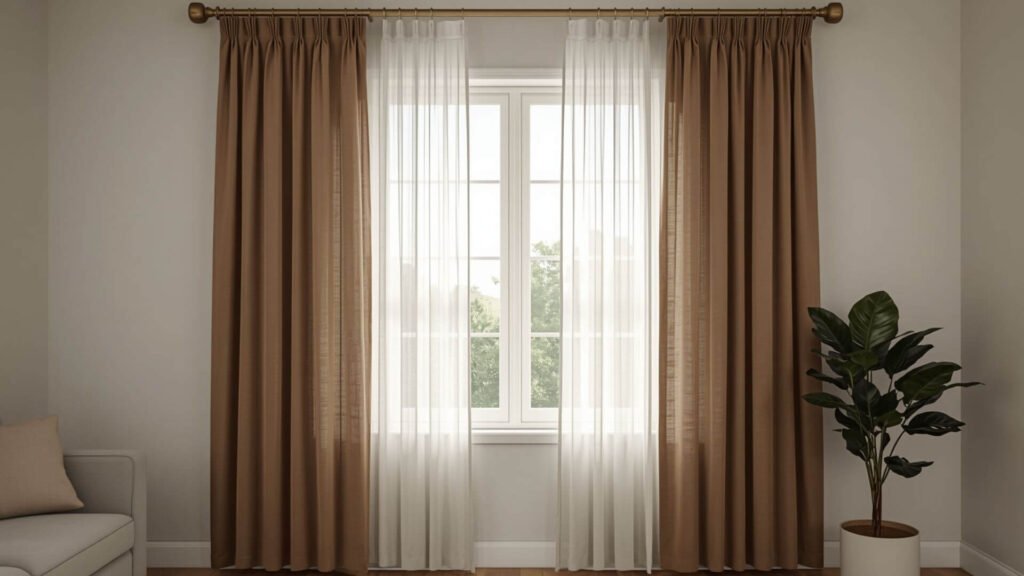
If you’ve ever admired a window treatment that looked custom-designed rather than store-bought, there’s a good chance it was layered. Layering curtains — pairing a sheer panel with a heavier drape — is one of the simplest techniques in interior design for adding depth, controlling light precisely, and improving privacy and insulation, all at once.
This guide covers exactly how to layer curtains: the hardware you need, which fabric pairings work best, the proportions professional designers use, and the mistakes that make layered curtains look bulky instead of intentional.
1. What Does "Layering Curtains" Actually Mean?
Layering curtains means hanging two (or more) window treatments on the same window — typically a lightweight sheer curtain on an inner rod and a heavier, often light-blocking drape on an outer rod — so each layer can be opened or closed independently.
There are two common approaches:
- True layering (recommended): Two separate panels on a double curtain rod or double track system, each moving independently.
- Attached layering: A sheer sewn directly onto an opaque curtain, hung from a single rod. This requires less hardware but limits you to moving both layers together, which sacrifices most of the functional benefit.
For real light and privacy control, designers consistently recommend true layering with independent panels.
2. Why Layer Curtains: The Real Benefits
3. Hardware You Need

| Benefit | What It Does |
|---|---|
| Light control | Close the sheer for diffused light; close both for full blackout; open both for maximum light |
| Privacy | Sheers obscure the interior during the day without blocking light; heavier drapes provide full privacy at night |
| Visual depth | Two fabric weights and colors create dimension that flat, single-panel curtains can’t |
| Insulation | An added fabric layer reduces drafts and can help moderate room temperature |
| Sound dampening | Heavier outer drapes, especially with lining, reduce ambient noise — useful in urban or noisy homes |
| UV protection | A blackout or lined outer layer blocks significant UV exposure, protecting furniture and flooring from sun fade |
Why it matters: A single curtain panel only gives you two states — open or closed. Layering gives you a full range between those extremes, which is the main reason designers treat it as a functional upgrade, not just a decorative one.
This is the part most people get wrong — the right hardware determines whether layered curtains function well or just look cluttered.
Double curtain rod or double track system The foundation of layering. Two parallel rods — a thinner back rod for the sheer, a more decorative front rod for the main drape — let each panel move independently.
- Wide-set systems: More space between rods; easier independent operation; better for larger windows.
- Compact systems: Rods set closer together; suited to smaller windows or tighter spaces.
- Wooden rod systems: Add warmth, suited to traditional or rustic interiors.
Brackets
- Double brackets — purpose-built to support both layers and prevent sagging.
- Center support brackets — recommended for windows wider than 30 inches.
- No-drill brackets — useful for rentals or where wall damage isn’t an option.
Finials Beyond decoration, finials stop panels from sliding off the rod ends. Match the finial finish to your rod hardware for a cohesive look.
The critical spacing rule: Leave at least 3 inches of clearance between the two rods. Too little spacing causes the layers to catch on each other and lets the back layer’s silhouette show through the front panel in direct sunlight.
Header styles worth considering: pinch pleat, pencil pleat, and cartridge pleat headers give a tailored, designer look. For a minimal, hardware-free appearance, a hidden-track drapery system is the modern alternative.
4. Best Fabric Combinations for Layered Curtains

| Inner Layer (Sheer) | Outer Layer (Heavier) | Best For |
|---|---|---|
| Linen sheer | Blackout curtain | Bedrooms, full light control |
| Synthetic (polyester/nylon) sheer | Thermal curtain | Energy efficiency, temperature regulation |
| Wool sheer | Velvet drape | Formal living rooms, added warmth and texture |
| Sunbrella sheer | Lined cotton drape | High-durability spaces, sunrooms |
Why pairing matters: Two fabrics of the same weight (e.g., two mid-weight cottons) tend to look bulky and flat. Designers follow what’s sometimes called a 1-to-3 texture ratio — pairing a gauzy, lightweight sheer against a noticeably heavier, denser drape — to create visible contrast and depth.
A growing 2026 trend is textured sheers — fabrics with subtle slubs or metallic threads that stay visually interesting even when the outer drape is fully open.
5. Step-by-Step: How to Layer Curtains

- Measure your window — width (for rod sizing) and the drop length you want (sill, floor, or puddle length).
- Choose your hardware — select a double rod or double track system sized to your window width, with center support if wider than 30 inches.
- Install the back rod first — mount it closest to the wall/window frame; this will hold your sheer.
- Install the front rod — mount it with at least 3 inches of clearance from the back rod; this holds your heavier drape.
- Hang the sheer panel on the back rod.
- Hang the heavier drape on the front rod.
- Adjust lengths — the inner (sheer) layer should be slightly shorter than the outer layer so it doesn’t peek out underneath.
- Style with tiebacks or holdbacks — use these to hold the heavier drape open during the day so the sheer can filter light on its own.
- Test all four light/privacy combinations — sheer only, drape only, both open, both closed — to confirm smooth, independent operation.
6. Length, Proportion, and the 1-to-3 Texture Rule

Two proportion rules consistently show up across professional layering guides:
- Length hierarchy: The drapery closest to the window (the sheer) should be cut slightly shorter than the layer hung over it, so it doesn’t show beneath the outer panel.
- Weight/texture contrast: Pair a lightweight, gauzy sheer with a noticeably heavier, interlined drape rather than two fabrics of similar weight.
Common drapery length options include sill length, apron length, floor length (the most popular, stopping about 2 inches from the floor), trouser length (breaking at the floor), and puddle length (dramatic, pooling on the floor).
7. Color and Pattern Coordination

- Use the 60-30-10 rule: 60% dominant color, 30% secondary color, 10% accent — apply this across your sheer, drape, and room palette.
- Complement or contrast: Match your curtains to existing furniture for cohesion, or choose a deliberate contrast for a bolder statement.
- Tone-on-tone layering: A 2026 design trend pairs warm off-white sheers with sandy or taupe outer drapes, creating depth through shadow and weave rather than strong color shifts.
- Mixing patterns: If using a patterned outer drape, keep the sheer solid (or vice versa) — give patterns room to stand out rather than competing with another pattern.
8. Room-by-Room Layering Advice
Bedroom: Prioritize blackout drapes as the functional outer layer, paired with a sheer for daytime softness. This combination gives full darkness at night and gentle natural light during the day.
Living room: Favor flexibility — sheer plus a lighter, non-blackout drape — since living rooms are used at varying light levels throughout the day.
Windows with existing blinds or shades: Curtains can be layered over blinds or roman shades as the outer treatment. When the curtains are open, the shade remains visible and adjustable for fine light control; when closed, the curtains create a traditional, fully fabric-covered look.
The hardware you choose matters as much as the fabric in a bedroom. A slim, matte black double rod reads modern and minimal; a brushed brass rod adds warmth to neutral tones. For inspiration before you buy, check out these curated double curtain rod ideas for bedroom that work across a range of interior styles.
9. Common Mistakes to Avoid
- Pairing two fabrics of equal weight — creates a bulky, flat look instead of dimension.
- Insufficient rod spacing — less than 3 inches between rods causes layers to catch and silhouettes to show through.
- Inner layer longer than outer layer — looks unfinished; the sheer should sit slightly shorter.
- Skipping center support brackets on wide windows — leads to sagging rods over time.
- Attached sheer-to-drape panels when you want full functionality — looks layered but only opens/closes as one unit, defeating the main purpose of layering.
10. Layered Curtains vs. Layering Over Blinds/Shades
| Approach | Functionality | Best Use Case |
|---|---|---|
| Double curtain rod (sheer + drape) | Full independent control of both layers | Most rooms; maximum flexibility |
| Curtain over blinds/shades | Curtains for style, shade for precise daytime light adjustment | Rooms needing fine-tuned light control with a soft fabric finish |
| Attached sheer-to-drape panel | Limited — both layers move together | Budget or single-rod setups where some visual layering is enough |
| Valance over drapery | Decorative top treatment only, no functional light control | Adding a finished, dressed-up look; hiding hardware |
11. Entity Glossary
- Drapery / Drapes: Heavier fabric window panels, often lined, used for privacy and light control.
- Sheer curtains: Lightweight, semi-translucent panels that filter light while maintaining some visibility/airiness.
- Blackout curtains: Curtains constructed (often with a special lining) to block nearly all incoming light.
- Thermal curtains: Curtains designed with insulating properties to regulate room temperature.
- Double curtain rod / double track system: Two parallel rods or tracks allowing two independently operable curtain layers.
- Valance: A short decorative panel covering the top of a window, used for styling rather than function.
- Tiebacks / Holdbacks: Accessories used to hold curtain panels open to one side.
- Finials: Decorative end-pieces on a curtain rod that also prevent panels from sliding off.
- Pinch pleat / pencil pleat / cartridge pleat: Curtain header (top) styles that affect how fabric folds and hangs.
- Hidden-track drapery: A track system concealed from view for a minimal, hardware-free look.
Conclusion & Action Steps
Layering curtains is a straightforward upgrade with an outsized visual and functional payoff: better light control, more privacy options, added insulation, and a noticeably richer-looking window. The formula is consistent across every well-designed layered window: a double rod with proper spacing, a deliberate weight contrast between sheer and drape, and slightly shorter inner panels.
To get started:
- Measure your window and choose a double rod or track system sized to fit.
- Select your fabric pairing based on the room’s main need (light-blocking for bedrooms, flexibility for living rooms).
- Install with at least 3 inches of rod clearance.
- Hang sheer shorter, drape longer.
- Style with tiebacks for a finished, designer look.
If you haven’t selected your hardware yet, it’s worth comparing a few well-reviewed double curtain rod or double track system options to find one that matches your window size, curtain weight, and interior style. Choosing quality hardware now can save you from replacing sagging or poorly functioning rods later.
Once you have your fabric pairing sorted, the rod is your next decision—and in a bedroom it is worth getting right. These double curtain rod ideas for bedrooms will help you choose a style and finish that ties the whole window treatment together.
People Also Ask
Q: What is the best way to hang two layers of curtains?
A double curtain rod or double track system, with the sheer on the back rod and the heavier drape on the front rod, gives both layers full independent movement.
Q: Do you need a double rod to layer curtains?
Not strictly — sheer-attached panels exist on a single rod — but a double rod is needed for full independent control of each layer, which is the main benefit of layering.
Q: What fabric goes behind sheer curtains?
Blackout, thermal, or velvet drapes are the most common heavier fabrics layered behind (in front of, on the outer rod from) sheer curtains.
Q: How far apart should double curtain rods be?
At least 3 inches of clearance is recommended between the two rods to prevent the layers from catching or showing through each other.
Q: Should sheer curtains be shorter than the outer curtains?
Yes — the inner (sheer) layer is typically cut slightly shorter than the outer drape so it doesn’t peek out beneath it.
Q: Can you layer curtains over blinds?
Yes — curtains can be layered as the outer treatment over blinds or roman shades, combining a soft fabric look with the shade’s adjustable light control.
Q: Is layering curtains worth it?
For most rooms, yes — it adds visual depth, finer light and privacy control, and some insulation/sound dampening benefits compared to a single curtain layer.