
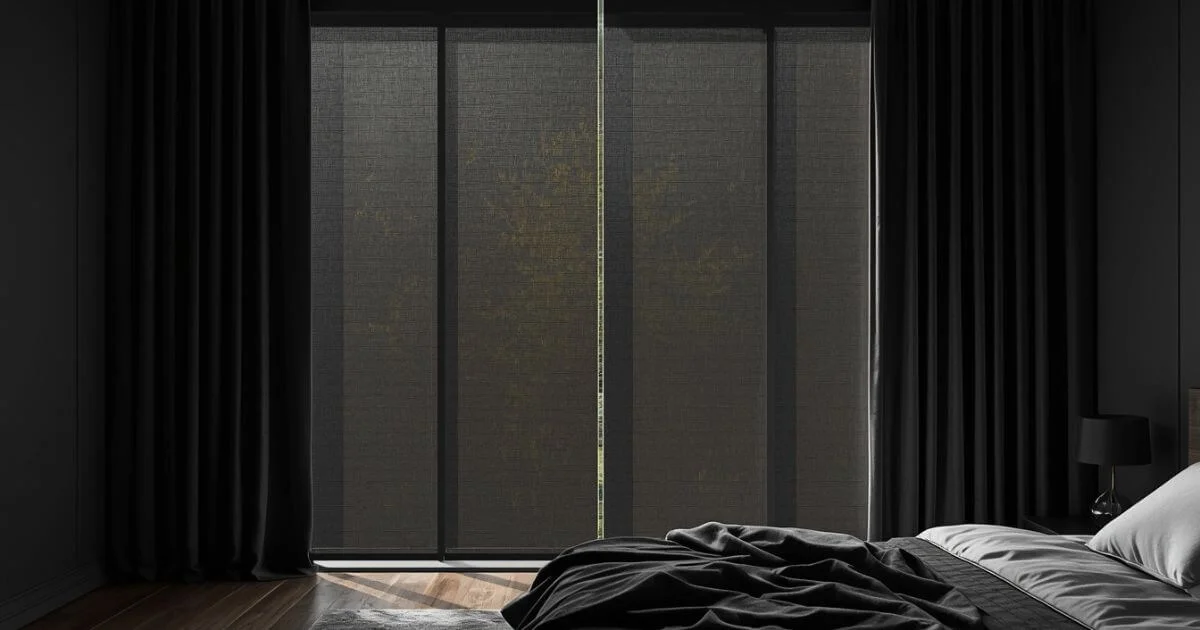
Blackout curtains are curtains built to stop light passing through the fabric itself. Where a regular curtain only softens daylight, a blackout curtain uses a dense weave, a coated backing, or a separate blackout lining to block most or all of it — so a bedroom can stay dark at noon, not just at night.
That one difference explains almost everything else about them: why they help you sleep, why they are heavier than normal curtains, and why how you hang them matters as much as what you buy. Our curtains guide covers measuring, fabrics and hanging styles for every room; this guide stays on blackout — what it is, how it works, how it compares, and how to choose and hang a set that actually delivers a dark room.

How Do Blackout Curtains Work?
There is no single blackout fabric. Manufacturers block light in three different ways, and knowing which one you are buying tells you a lot about how the curtain will feel, hang and wash.
A triple weave fabric weaves a black yarn core between two layers of colored yarn. There is no coating and no separate lining — the dark core does the work. These panels drape the most like ordinary curtains and are usually the easiest to wash. Most block the great majority of light, though very pale colors can let a faint glow through in hard, direct sun.
A coated fabric carries layers of foam on its back, applied in “passes.” A 3-pass lining — white foam, a black layer, then white foam again — is the classic construction, and 4-pass versions add another layer for good measure. Coated panels can block light completely at the fabric, but the foam backing is the delicate part: it does not love hot water, ironing or rough washing.
A lined curtain keeps the two jobs separate. The face fabric you see can be linen, cotton, velvet — anything — and a blackout lining hangs behind it and does the blocking. This is how a light, natural-looking curtain can still black out a room, and it is also how you can turn curtains you already own into blackout curtains, by adding a liner.

Whichever construction you choose, remember the limit every honest guide states: “100% blackout” describes the fabric, not the finished room. Light that cannot get through the panel will still try to get around it — over the top, down the sides, through the center gap and under the hem. The sections on hanging below are about closing those four gaps.
Complete Blackout vs Semi Blackout
Blackout is not regulated, so labels vary — but in practice you will meet two levels.
Complete blackout curtains are built to block up to 90–100% of light through the fabric. Choose them when darkness is the whole point: sleeping during the day, a baby’s nap schedule, a streetlight outside the window.
Semi blackout curtains — usually sold as room-darkening curtains — cut most daylight and glare but let a soft brightness remain. The room goes dim and restful, not dark. That suits living rooms, TV rooms and anyone who wants to take the edge off the sun without living in a cave.

| Complete blackout | Semi blackout (room darkening) | |
|---|---|---|
| Light through the fabric | Up to 90–100% blocked | Most blocked; a soft glow remains |
| Typical build | Triple weave, 3/4-pass coating, or lined | Tighter weave or a light lining |
| Room result | Dark, day or night | Dim and calm |
| Best for | Bedrooms, nurseries, shift workers, media rooms | Living rooms, home offices, glare control |
 Our blackout vs room-darkening curtains guide walks through the two in more detail, including which one belongs in each room.
Blackout vs Room Darkening vs Light Filtering vs Thermal
These four labels get mixed up constantly, so here is the plain version. Light filtering curtains soften daylight and keep a room bright. Room darkening cuts most of it. Blackout is built to stop it. Thermal is a different claim altogether — it describes insulation, not darkness — and one curtain can carry several of these labels at once.
| Type | What it does to light | What else it does | Best for |
|---|---|---|---|
| Light filtering | Softens and spreads it; room stays bright | Daytime privacy only | Living rooms, kitchens |
| Room darkening | Blocks most; room goes dim | Good privacy, some insulation | Living rooms, offices, relaxed bedrooms |
| Blackout | Blocks up to 90–100% through the fabric | Strongest privacy; insulates as a side effect | Bedrooms, nurseries, media rooms |
| Thermal | Varies — may or may not block light | Slows heat loss and heat gain at the glass | Drafty or sun-baked rooms |
If heat and drafts are your main problem rather than light, compare before you buy: our blackout vs thermal curtains guide covers the differences, pros and cons and costs, and our thermal curtains guide explains how insulating fabrics are put together.
What Are Blackout Curtains Used For?
Sleep comes first. Darkness is the signal your body uses to produce melatonin and keep its circadian rhythm — its internal sleep-wake clock — on schedule. A room that stays bright at 5 a.m. in summer, or glows all night from streetlights, keeps interrupting that signal. Blackout curtains remove the interruption.

The same panels earn their keep in other ways:
- Daytime sleep for shift workers, and naps for babies and young children who go down while it is still light outside
- Media rooms and home theaters, where screen glare ruins the picture
- Privacy — an opaque panel cannot be seen through, day or night
- Protecting furniture, rugs and wood floors from UV fading, by keeping direct sun off them during the brightest hours
- A calmer temperature, covered in the next section

Do Blackout Curtains Keep Heat Out?
Partly — and it helps to know why. Sunlight that lands on your floor and furniture turns into heat in the room. A closed blackout curtain intercepts a good share of that sunlight before it lands, and the trapped layer of air between curtain and glass slows heat moving through the window in both directions: less heat in during summer, less heat escaping in winter.
Two things decide how much cooling you actually feel. The first is the backing color: a white or light backing facing the glass reflects sunlight back out, while a dark fabric absorbs it and re-radiates some of it into the room. The second is fit — heat flows around a curtain with big gaps just as light does. So expect a noticeable improvement on a sunny west-facing window, not a replacement for air conditioning. Our guide on whether blackout curtains actually make a room hotter takes the worry apart in full, because the honest answer surprises most people.
Pros and Cons of Blackout Curtains
Pros
- Near-total darkness for sleep, naps and daytime sleeping
- Complete privacy — nobody can see in, even with your lights on
- Blocks UV that fades furniture, rugs and flooring
- Helps with heat in summer and drafts in winter
- Works in rentals: no permanent changes, and they move with you
- Available in light colors and prints now, not just dark hotel styles
Cons
- Heavier than regular curtains, so they need a sturdy rod or track
- Usually cost more than standard panels
- A closed blackout curtain makes the room dark at midday too — you will use your lamps more
- Foam-backed coatings need gentler care and can be damaged by machine washing or ironing the back
- Oversleeping is a real thing: with no morning light cue, some people find waking up harder at first
What Fabric Is Best for Blackout Curtains?
For most bedrooms, triple weave polyester is the safe default: it blocks light well, drapes softly, and tolerates the washing machine. If you want a natural look — linen, cotton, a velvet with real texture — choose that face fabric with a proper blackout lining behind it rather than hoping the face fabric alone will do the job. It will not.
One habit worth stealing from people who sell curtains for a living: check the lining, not the pretty side. Hold the panel up to a bright window, or put your phone’s flashlight against the back of the fabric. If you can see the light glowing through, so will the sunrise. A good blackout fabric shows nothing.

Header Styles: Grommet, Rod Pocket, Back Tab, Pinch Pleat
The header — how the curtain hangs from the rod — changes both the look and the light leaks.
- Grommet (eyelet): slides easily, folds in even waves. The grommet holes sit above the rod line, so a little light can pass over the top; mount the rod higher to compensate.
- Rod pocket: fabric bunches on the rod for a soft, traditional look. The pocket holds the panel close to the wall, which helps at the top, but these panels are slower to slide open and closed daily.
- Back tab: hidden loops behind the panel give a clean, tailored look and let the fabric sit flat against the light — a practical favorite for bedrooms.
- Pinch pleat: the formal option, usually on rings or a track. On a ceiling-mounted track it gives the tightest seal of all.
If side leaks are your battle, look at wrap-around (return) rods, which curve the panel back to the wall at each end, or a ceiling-mounted track, which removes the top gap entirely.

Blackout Curtain Sizes: Widths, Lengths and Fullness
Ready-made blackout panels come in a few standard widths — most often 42, 50 or 52 inches per panel, with extra-wide panels up to about 100 inches for sliding doors and picture windows. Standard lengths are 63 inches (to the sill), 84 inches (the most common, floor length in a room with an 8-foot ceiling), and 95 or 108 inches for taller rooms.
Blackout sizing has one rule decorative curtains can ignore: buy for coverage, not for the window’s exact measurements.
- Width: the combined fabric should be 1.5 to 2 times the rod length, so the panels still fold softly when closed and overlap in the middle instead of just meeting. For a near-total seal, lean toward 2 times.
- Rod placement: extend the rod roughly 6 to 12 inches past the frame on each side, and mount it 4 to 6 inches above the frame — higher if you are chasing the last of the top light.
- Length: floor length blocks the most light. A hem that stops at the sill always leaves a bright line underneath.
A worked example: for a 48-inch-wide window, a rod spanning about 66 inches (frame plus roughly 9 inches a side) with two standard 52-inch panels gives you 104 inches of fabric — about 1.6 times the rod, with enough overlap to close the center gap. Our curtain calculators will run the width, panel count and rod numbers for your exact window before you order.
How Much Do Blackout Curtains Cost?
Blackout curtains cost more than basic panels because there is more in them — extra layers, linings and weight. As a general guide for ready-made curtains in the US: a standard pair of one-layer blackout panels typically falls somewhere around $30–$80, with budget pairs below that and heavier lined or textured pairs above it. A separate blackout liner to add behind curtains you already own usually runs about $20–$80 per panel. Custom and made-to-measure blackout curtains sit in a different bracket entirely and can run into the hundreds per panel once fabric, lining and pleating are added.
The pair-versus-single trap catches a lot of buyers: some listings price one panel, some price a pair, and a window almost always needs two. Check what is actually in the box before comparing prices.
How to Choose Blackout Curtains
- Decide how dark the room truly needs to be — complete blackout for sleep and nurseries, semi blackout for living spaces.
- Pick the construction: triple weave for easy care, coated for maximum block at the fabric, lined for a natural face fabric.
- Do the flashlight test if you are shopping in person; if you are ordering, read how the blackout is achieved, not just the claim.
- Size for coverage using the rules above — rod wider and higher than the frame, fabric at 1.5 to 2 times the rod, floor length.
- Match the header to the room: back tab or pleats for a tight, tailored seal; grommets where the curtains open and close a lot.
- Think about layering. A sheer in front of a blackout panel gives you soft daylight and privacy by day and real darkness at night. Our guide to layering sheer and blackout panels in the bedroom shows the combination on a real window.
- Check the care label before the curtains go in the cart, especially for nurseries, where they will be washed often.
Hanging Them So the Room Actually Goes Dark
This is where most blackout setups succeed or fail, and none of it costs money.

Mount the rod high and wide, as covered above, so the panels cover wall — not just glass — on every side. Overlap the two panels at the center instead of letting them merely meet; a small overlap removes the bright vertical line down the middle. Let the hem reach the floor so no light slips underneath. If light still pours over the top, switch to a wrap-around rod or a ceiling-mounted track. And for the last stubborn side gaps, hanging the blackout panels over blinds or a shade gives you two barriers instead of one — it is the combination hotels use, and it works at home for the same reason.

Can You Turn Regular Curtains into Blackout Curtains?
Yes — buy a blackout liner. Liners hang from the same rod behind your existing panels (on a double rod, or clipped to the same rings), and they turn a linen or cotton curtain you love into a blackout curtain without changing how the room looks from inside. It is the cheapest route if your current curtains are in good shape, and the liner can come off again in winter or when you move.
Care: Washing, Creases and Smells
Care depends on the construction, so the label is the law. Triple weave panels are usually machine washable on a cold, gentle cycle. Foam-backed coated panels are the exception: hot water, tumble drying and ironing the backing can crack or peel the coating, so those are better spot-cleaned or steamed gently from the face side, and many makers say do not machine wash at all.
New blackout curtains often arrive creased from the packaging. Most creases fall out after a few days of hanging; for the stubborn ones, our guide on how to get wrinkles out of blackout curtains covers the safe methods for lined and coated fabrics. A chemical, “new fabric” smell is common too, usually from the coating or the packaging. Air the panels in a ventilated room or outside for a day and it normally clears. If it lingers, our guide on why blackout curtains smell explains the causes and the fixes.
Do Blackout Curtains Reduce Noise?
A little, and it is worth being straight about this. Thick, layered fabric absorbs some sound and softens echo in the room, so a busy street sounds slightly muffled behind blackout curtains. They are noise-reducing, not soundproofing — no curtain can do that job. If noise is your main problem, treat blackout curtains as a small bonus, not the solution.
Are Blackout Curtains Bad for Your Health?
No — used normally, they are one of the simpler sleep upgrades there is, and the darkness they create supports the melatonin cycle your body runs on. Two sensible notes rather than warnings. First, air new coated panels before hanging them, as above; if you prefer to avoid synthetic backings altogether, fabric triple weave and lined cotton options exist. Second, total darkness removes your morning light cue, so if you find waking up sluggish, open the curtains first thing or choose semi blackout for a gentler start.
Bottom Line
Everything about blackout curtains comes down to three decisions: the construction (triple weave, coated, or lined), the level (complete or semi), and the fit (wide, high, overlapping, floor length). Get those three right and the fabric can do the job it was made for — a dark, private, calmer room whenever you close the panels.
Frequently Asked Questions
What are blackout curtains used for?
Blackout curtains are used to block light for better sleep, daytime naps and shift work, to keep nurseries dark, to cut glare in media rooms, and to add complete privacy. As a side benefit they also block UV that fades furniture and help a room hold its temperature.
Are blackout curtains really 100% blackout?
The fabric can be. Good complete blackout fabric blocks up to 90–100% of light passing through it. The room is a different question: light still enters around the edges if the panels are too narrow, too short, or hung tight to the frame. Wide, high, overlapping, floor-length panels are what turn blackout fabric into a blackout room.
Do blackout curtains keep heat out in summer?
They help. A closed blackout curtain shades the room from direct sun and traps a layer of air against the glass, and a white or light backing reflects more sunlight back out. Expect a noticeable difference on sunny windows — just not air-conditioning levels of cooling.
What is the difference between room darkening and blackout curtains?
Room darkening curtains block most daylight so a room goes dim, but a soft glow remains. Blackout curtains are built — by weave, coating or lining — to stop light passing through the fabric, so the room can go properly dark. Blackout is the choice for sleep; room darkening suits living spaces.
What fabric is best for blackout curtains?
Triple weave polyester is the easiest all-round choice: it blocks light well, drapes softly and is usually machine washable. For a natural look, pick a linen, cotton or velvet face fabric with a proper blackout lining behind it — and judge any blackout curtain by its lining, not its face.
What size blackout curtains do I need?
Start with the rod, not the window: mount it 6 to 12 inches wider than the frame on each side and 4 to 6 inches above it, then buy combined fabric 1.5 to 2 times the rod length. Standard panels are most often 42, 50 or 52 inches wide, in 63, 84, 95 or 108 inch lengths, and floor length blocks the most light.
Can I make my existing curtains blackout?
Yes. Add a blackout liner behind them — hung from a double rod or clipped to the same rings — and the lining does the light blocking while your current curtains keep the look. Liners typically cost about $20–$80 per panel and can be removed whenever you like.
Do blackout curtains block noise?
Only slightly. Their dense, layered fabric absorbs some sound and softens echo, so traffic sounds a bit more muffled, but they are not a soundproofing product. Buy them for darkness; treat any quiet as a bonus.
Keep Exploring Biya Decor
New to the blog? Start with our complete guides: Curtains Guide · Blinds Guide · Sofa Fabric Guide · Bed Sheets Guide
Written by Bushra Noreen, founder of Biya Decor, drawing on 15+ years of hands-on experience with curtains and fabrics. Read our story.