
Table of Contents
ToggleDo Blackout Curtains Actually Make a Room Hotter? Perfect Guide
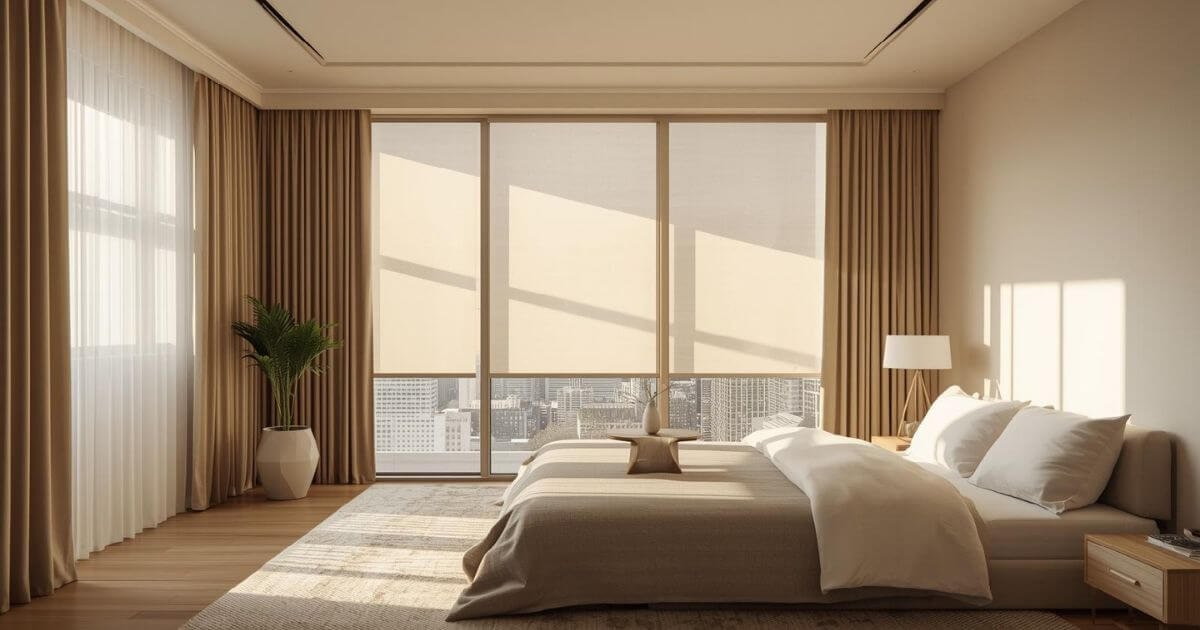
Do blackout curtains actually make a room hotter?
Short answer: not usually. In most homes, blackout curtains reduce heat by blocking sunlight before it enters the room. However, under certain conditions—poor airflow, dark heavy fabrics, or improper use—they can trap warmth and make a space feel hotter.
To understand why both can be true, it helps to look at how heat really moves through windows and fabrics.
How blackout curtains work
Blackout curtains are made from tightly woven, multi-layer fabrics designed to block 80–100% of incoming light. Many include a foam, acrylic, or thermal backing that also limits heat transfer.
They affect room temperature by influencing three main processes:
1. Radiative heat (sunlight)
Sunlight passing through glass turns into heat once it hits indoor surfaces. This is called solar heat gain. Blackout curtains block much of that radiation before it enters, which is why rooms with heavy sun exposure often feel noticeably cooler when the curtains are closed.
2. Conduction (heat moving through materials)
Thick fabrics slow the movement of heat. When used correctly, blackout curtains add a small insulation barrier that reduces heat flow between the window and the room.
3. Convection (air movement)
Air trapped between the curtain and the window can warm up. If that warm air can’t circulate back into the room or escape, it can create a pocket of heat that makes the area feel stuffy.
Whether blackout curtains cool or warm a room depends on which of these effects dominates.
When blackout curtains usually make rooms cooler

In many U.S. homes, especially in sunny regions, blackout curtains tend to lower room temperature.
They’re most helpful when:
Windows face east, west, or south and receive direct sun
The room heats up mainly because of sunlight, not appliances
Curtains are closed before peak sun hours
The fabric includes a thermal or reflective backing
The window is single-pane or poorly insulated
In these situations, blackout curtains significantly reduce solar heat gain. Less sunlight entering means less heat converted inside the room.
Common examples:
A west-facing bedroom in Texas that overheats in late afternoon
A top-floor apartment in Arizona with strong sun exposure
A home office in California where screens and desks heat up quickly
Here, blackout curtains often make the space noticeably more comfortable and can reduce reliance on air conditioning.
When blackout curtains can make a room feel hotter

Blackout curtains don’t generate heat. But they can trap it.
Rooms may feel warmer when:
The space already produces heat (electronics, people, appliances)
Curtains are very thick and sealed tightly to the wall
There is little airflow or ventilation
Dark fabrics absorb heat and there’s no circulation
Curtains stay closed at night during hot, humid weather
In these conditions, warm air becomes trapped between the curtain and window. Without circulation, the area can feel muggy, and the room may seem hotter than before.
This is most noticeable in:
Small bedrooms
Humid coastal climates
Poorly ventilated apartments
Rooms where curtains stay closed 24/7
The issue isn’t the blackout function—it’s air management.
The science behind blackout curtains and temperature
Understanding the basics of building science makes the effect clearer.

Solar heat gain
Windows act like light funnels. When sunlight enters, it becomes heat. Blocking it outside the glass or right at the window surface is one of the most effective ways to reduce indoor temperature.
Thermal resistance (R-value)
Some blackout curtains include insulating layers that increase thermal resistance. While they don’t compare to wall insulation, they can slow heat transfer and improve window performance.
Conduction, convection, radiation
Radiation: blackout curtains block it
Conduction: thick fabric slows it
Convection: poor airflow can trap it
Cooling happens when radiation control dominates. Warming happens when trapped convection dominates.
Blackout curtains vs other window treatments

| Feature | Blackout curtains | Thermal curtains | Solar shades / films | Cellular (honeycomb) shades |
|---|---|---|---|---|
| Light control | Excellent | Very good | Moderate | Moderate |
| Heat blocking | Medium–high | High | High | High |
| Insulation | Moderate | High | Low–moderate | High |
| Airflow | Low | Low–moderate | High | Moderate |
| Room darkening | Maximum | High | Low | Low–moderate |
| Risk of heat trapping | Medium | Low–medium | Low | Low |
| Best for | Sleep, media rooms | Energy control | Sun heat reduction | Insulation & efficiency |
Blackout curtains focus on light control first, heat control second. Thermal curtains and cellular shades are designed more directly for insulation.
Climate matters: what works best across the U.S.

Hot, sunny regions (TX, AZ, NV, FL, Southern CA)
Primary problem: intense solar heat gain
Blackout curtains usually cool rooms
Choose lighter fabrics or reflective backings
Ventilation matters to prevent trapped humidity
Cold regions (MN, MI, NY, New England)
Primary problem: heat loss in winter
Blackout curtains often help retain warmth
Open during sunny days, close at night
Darker colors can even assist passive warming
Humid coastal regions (Gulf Coast, Southeast)
Primary problem: heat + moisture
Blackout curtains block sun but can trap humidity
Pair with fans, dehumidifiers, or layered sheers
Avoid sealing them too tightly
Mild climates (Pacific Northwest, Northern CA)
Benefits vary seasonally
Layered systems give the most flexibility
How to use blackout curtains so they don’t trap heat

Summer setup (cooling focus)
Close curtains before direct sunlight hits the glass
Leave a small gap at the top or sides
Use fans or AC circulation
Open them in the evening to release built-up heat
Choose light-colored or reflective linings
Winter setup (insulation focus)
Open curtains during sunny daytime hours
Close them fully after sunset
Let them rest close to the wall to limit drafts
Keep fabric clear of heaters and radiators
Installation tips that make a difference
Wraparound curtain rods reduce side heat leaks
Ceiling-mounted tracks limit sun gaps
Thermal linings improve insulation
Layered systems allow airflow control
Color, fabric, and construction: why details matter
Fabric thickness
Heavier fabrics slow heat movement but increase the chance of trapping warm air.
Backing material
Acrylic and foam backings block light well. Reflective thermal backings reduce heat absorption.
Color choice
Light colors reflect more radiant heat
Dark colors absorb more but can help in cold climates
Fit
Tight seals improve insulation but increase the need for controlled ventilation.
Common myths about blackout curtains and heat
“Blackout curtains always make rooms hotter.”
They block sunlight, which is the biggest heat source in most rooms.
“Blackout means thermal.”
Some only block light. Thermal performance depends on materials and lining.
“Dark curtains are bad for hot rooms.”
Color matters less than reflective backing and airflow.
“They replace proper insulation.”
They supplement it. They don’t replace wall insulation or energy-efficient windows.
Discover more at biyadecor.
When blackout curtains might not be the best solution
Kitchens with heavy internal heat
Rooms that rely on cross-ventilation
Humid environments without fans
Spaces where light is the main cooling tool
In these cases, solar films, cellular shades, or exterior shading may be better first-line options.
Real-world scenarios
A west-facing apartment bedroom in Phoenix:
Blackout curtains closed at noon dramatically reduce late-afternoon heat. Opening them at night prevents trapped warmth.
A nursery in Florida:
They block sun and improve naps, but layered sheers allow airflow to control humidity.
A winter living room in Michigan:
Blackout curtains retain indoor warmth at night and open during sunny days for passive heat.
Do blackout curtains help with energy comfort?
They often do. By limiting solar heat gain in summer and slowing heat loss in winter, blackout curtains can reduce temperature swings and support more stable indoor comfort. That doesn’t replace proper window glazing, but it can complement it—especially in older U.S. homes.
Safety and indoor comfort considerations
Avoid placing heavy blackout curtains directly over heaters
Choose low-odor, non-toxic fabrics
Keep airflow active in humid climates
Check for moisture buildup behind curtains
Comfort depends on temperature and air quality.
Conclusion
Blackout curtains don’t automatically make a room hotter. In many U.S. homes, they actually make rooms cooler by blocking solar radiation before it turns into heat. Problems arise only when thick fabrics trap warm air without ventilation.
Used strategically—based on climate, season, and airflow—blackout curtains can be valuable tools for comfort, light control, and indoor temperature management.